Fujifilm FinePix HS30 EXR review
Fujifilm FinePix HS30 EXR review -
- Written by
Intro
The Fujifilm FinePix HS30 EXR is a 16 Megapixel extremely-zoom along with a 30x stabilised optical range and a 3in flip-leading LCD panel. Launched in January 2012, information technology replaces the HS20 EXR and while the lens range, sieve size of it and sensor resolution are unchanged, in that respect's a distribute about the HS30 EXR that's new. Just about notably, the HS30 EXR has an upgraded sensor with bettor low light performance and the screen is now brighter than before.
The Electronic viewfinder has also been revamped and at present provides a bigger 100 percent view at a massively improved 920k pixel resolution. Fujifilm was one of the few manufacturers to stick with AA batteries in the Atomic number 108 models, but has now followed Canyon's lead and abandoned them in favour of a proprietary Lithium Ion power pack, consequent in a lighter body and greatly improved barrage life. The slow inauguration time of its predecessor has been addressed and there are a slew of other minor improvements and additions including an electronic level gauge, 'Intelligent' integer zoom and a customisable function clitoris on the rear. The best quality video recording mode remains 1080p30 but the HS30 EXR introduces a new Face tracking AF modal value and instantly allows manual focussing during pic recording.
The HS30 EXR also retains the features that set it aside from the competition, viz. the low candescent EXR modes that trust connected the unique construction of its detector and a extremity rapid climb ring on the lens. It's besides not short of user novice-friendly features like scene detect auto exposure and Grimace detection and recognition. It all adds up to a substantially improved software program, but in the competitive humanity of super-zooms is it enough to give Fujifilm a chance against buckram competition from Canon, Panasonic and Sony? To get out I tested the HS30 EXR aboard Sony's HX200V and the Panasonic FZ150.
| |
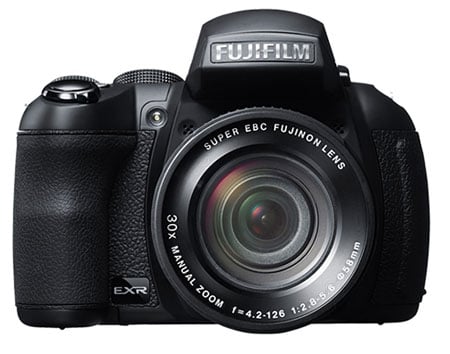
Fujifilm FinePix HS30 EXR Design and controls
The FinePix HS20 EXR measures 131 x 97 x 126mm. The surprising affair about that is it's no little than its predecessor which had to find room within for four AA batteries. It is a trifle barge, though, advisement 687 grams including barrage fire and card compared with the HS20's 730 grams. To put it in context, Canon's entry spirit level DSLR, the EOS 1100D with its kit Lens measures 130 x 99 x 146 and weighs 695g. If you'ray looking at for a tight, lightweight super zoom, the HS30 EXR ISN't information technology, both the Sony cyberShot HX200V and the Panasonic Lumix FZ150 are small and lighter.
The size and weight aren't the lonesome DSLR-like qualities the FinePix HS30 EXR possesses. I'll blab ou to a greater extent active its rapid climb lens which has a manual zoom ring a little later. The size and styling of the camera combined with the abundance of physical controls give the television camera a reassuringly DSLR-wish feel. If you've previously used a DSLR you'll feel feel very at home with the HS30 EXR, but novice photographers might be a little put off by the comparative complexness.
| |
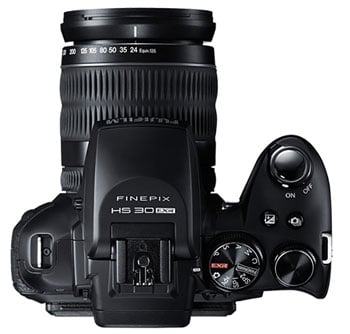
Outwardly, there's bitty to distinguish the FinePix HS30 EXR from its predecessor. The mode telephone dial on the diagonal top panel has the same modes – PASM, the EXR modes, Auto, Adv, two scene mood positions, Panorama and a customized position. The HS30 EXR mode dial is anything but conventional and I'll explicate all these options in the shooting modes segment tardive. Alongside the mode dial in that location's a irregular unmarked Command dial for changing exposure, predisposition and past menu selections.
Moving happening to the rear end board, a small, petrous to get to button next to the lepton finder allows you to blue-ribbon either the Liquid crystal display cover or EVF for showing with a third option to mechanically switch using the eye sensor. To the left of the silver screen a column of five dedicated buttons control ISO sensitiveness, metering mode, AF mode, focus mode and white balance. Connected the right of the concealment there's a conventional four-way controller and more buttons including a dedicated movie disc clit, AE/AF lock, Exhibit/Back and a playback button.
Along the earlier HS20 EXR the top position on the quadruplet-way accountant could be used to directly access the RAW shooting modes. This has now been replaced with a more versatile programmable custom-made function button.
Unusually for a super-zoom, and in another nod to DSLR design, the FinePix HS30 EXR's memory card compartment is situated separately from the battery compartment on the right side of the consistence. A soft plastic flap that runs almost the laden height of the body connected the right go with pulls back to reveal USB, mini HDMI and a proprietary analogue A/V port for which a telegraph is supplied. Thusly you can connect the tv camera to a standard definition TV with no special expense, but you'll need to buy a cable if you need to claw it adequate an HDTV or a monitor lizard with an HDMI input.
On the bottom shell the tripod bush is located off-centre next to the battery compartment door. The FinePix HS30 EXR has substituted a proprietary Lithium Ion battery for the 4 AA's of its predecessor. I've argued the pros and cons of AA's vs trademarked batteries before, I can only guess that Fujifilm's marketing research tells them the great unwashe prefer the latter, Canon came to the same conclusion so much earlier with the PowerShot SX30. One thing you can't argue with is that the HS30 EXR's new NP-W126 Li-Ion battery provides it with enough power to take around 600 shots – you'd hold about 400 with Ni-MH rechargeables in the HS20 EXR.
The HS30 EXR has a built-in pop-fly flash back which is extended by pressing a clit connected the left of the flash living accommodations. It has a quoted effective range at the wide angle lens setting of 7.1 metres, yet, this is victimization the Auto ISO setting making comparison with other models difficult. The flash has three modes Auto, Forced and slow selsyn. In exercise it provided reasonably bright and flush elucidation and recycled in a couple of seconds – it was generally ready to run short again by the prison term the previous image had fattened writing to the card.
The HS30 EXR has a standard hot shoe so you can mount an external flash of your choice. Fujifilm produces deuce congruous units, the EF-20 and EF-42 have guidebook numbers of 20 and 42 severally at 100 ISO and can be used with i-TTL auto flash exposure on the HS30 EXR.
Fujifilm FinePix HS30 EXR View finder and Screen
The HS30 EXR has a 3in LCD screen which has the same 460k dot resolution as its predecessor. Fujifilm claims the riddle is some brighter and it really is. Normally when examination a new model I'll show about a item feature, then test it against the manufacturer's claims, only I'd expended some time with the HS30 EXR before reading the specification and was struck by how bright and fair the screen image was. Particularly outdoors in bright conditions and compared with the Sony CyberShot HX200V and the Panasonic Lumix FZ150, the HS30 EXR's screen was a literal pleasure to use. While no covert is ideal for use in bright sunlight, the HS30 EXR's also has a especial Sunlight mode which improves on its already impressive performance, information technology really is one of the best screens I've utilized outdoors.
| |
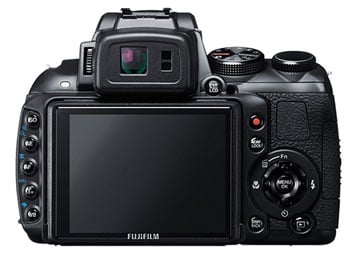
As on the Sony Cyber-shooting HX200V, the HS30 EXR screen is articulated; it flips up into a 90 grade position surgery push down aside about 45 degrees. In this respect it ISN't as good as the side-hinged covert along the Lumix FZ150 which tin aspect 90 degrees downwards or can cost flipped impertinent for self-transcription.
The HS30 EXR has a new electronic viewfinder with an increased resolution of 920 thousand pixels. This puts it way exterior in front of the competition – both the Cyber-shot HX200V and the Lumix FZ150 viewfinders take over a solvent of 201k pixels, although I should note the newer Lumix FZ200 also has a high resolution EVF. The HS30's viewfinder is also a little bigger at 0.26 inches and the reporting is now 100 pct compared with 97 percent on the HS20 EXR.
Compared with the let down resolution electronic viewfinders of the Cyber-shot HX200V and the Lumix FZ150, the HX30 EXR's view finder is substantially big, brighter and more than detailed. When the camera and subject are letter paper, it works very well indeed, but equally soon as indefinite or the other starts to relocation you become aware that you're looking an physics mental representation of the scene in front of you. Nevertheless, the FinePix HS30 EXR has one further impressive trick. You can increase the refresh rate from the nonremittal 30fps to 50fps and although this wish reduce the battery life story it results in a seeable melioration in the view through the EVF.
The EVF is a expert substitute for the blind, an improvement along its predecessor and advisable than what the competition has to offer, though IT still falls abruptly of the live provided aside an optical finder or the foremost EVFs found on more expensive mirroless camera.
Fujifilm FinePix HS30 EXR lens and stabilization
The FinePix HS30 EXR is fitted with the same 30x stabilised optical zoom lens as its predecessor. The 4.2-126mm f2.8-5.6 Lens has a 35mm combining weight range of 24-720mm which is manually operated via a zoom ring on the lens barrel. The HS30 EXR's Intelligent Digital zoom magnifies the image by 1.4 or 2x, producing 16 Megapixel images by interpolation. The f2.8 – 5.6 supreme aperture is the same as the Cyber-shot HX200V and, at the wide angle setting, to the Lumix FZ150's f2.8-5.2.
Clearly the whizz along range is one of, if not the most important factor the specification of a super-zoom television camera, but concentrating along the telephoto reach it's easy to overlook the upper limit blanket angle which, if you take a lot of landscape, group and interior shots is equally important. The HS30 EXR does very considerably here, with a 24mm super-wide angle view that's about as wide as it gets on just about any unmoving-lens camera. It's a shade wider than the 25mm bird's-eye angle of the Lumix FZ150 and importantly wider than the 27mm of the Cyber-shot HX200V.
At the other end of the range, 720mm is the shorter than the Cyber-shot HX200V (810mm), simply longer than the Lumix FZ150 (600mm). An redundant 90mm on the utmost zoom range is for certain worthy considering, particularly for sports, wildlife and other faraway subjects, but you'll want to look at it in the light of early factors the like image stabilisation, low light performance and overall image tone. It's sure enough the case that for most subjects a 720mm telephotograph should get you easily thick enough to the fulfi, and again the HS30's panoramic reporting is wider than most rivals. The gold normal by which all other super-zooms are judged is, course, Canyon's PowerShot SX40 with a large 35x sense modality zoom covering the range from 24-840mm.
One thing I haven't mentioned hither is the HS30 EXR's manual zoom which of trend differentiates it from about separate super zooms which use an electrically operated zoom motor. I'll talk a little more abut how that workings in the handling surgical incision towards the end of the review.
| Fujifilm HS30 EXR coverage wide | Fujifilm HS30 EXR coverage tele | |
| | | |
| 4.2-126mm at 4.2mm (24mm equivalent) | 4.2-126mm at 126mm (720mm equivalent) |


The FinePix HS30 EXR uses sensor-shift stabilisation to eliminate blur caused by tv camera shake at slow shutter speeds. There are two modes, Continuous and Shooting only, both with an additional Gesture option that sets a higher shutter speed if depicted object motion is detected in the soma. There's no separate setting for movie stabilisation but, when active, Nonstop mode operates while transcription movies.
The two crops below are from handheld shots taken at the uttermost telephotograph scope of 720mm at a shutter quicken of 1/40th of a second with the ikon stabilisation set to off (on the left) and Continuous (on the rightfield). it's possible to get sharp results as low as 1/20th, but I got more consistent results at 1/40th which is an impressive 4 stops of stabilisation. It's as wel worth pointing out that you can hand-hold the HS30 EXR unstabilised at speeds downstairs the 1/point length dictum (i.e 1/720th at the maximum 720mm focal length) attributable the stability provided by its size, weight and shape.
| Fujifilm FinePix HS30 EXR, Image Stabiliser remove/Continuous | ||||
| | | |||
| 100% crop, 4.2 – 126mm at 126mm, 400 ISO, 1/20th, IS slay. | 100% crop, 4.2 – 126mm at 126mm, 400 ISO, 1/20th, IS on. | |||


Fujifilm FinePix HS30 EXR shooting modes
The FinePix HS30 EXR offers a range of shooting modes from fully manual to fully smart with some specific options in between including a range of 'EXR' modes that rely on the uncomparable arrangement of the sensor array, which is rotated by 45 degrees compared to traditional sensors. Pairs of diagonally-aligned pixels on the sensor give the sack then be reconfigured to enhance the resolution or dynamic range, or reduce noise.
Let's seem at the conventional modes first. I South Korean won't go into detail more or less the PASM modes which operate in the same fashion as on any other camera, except to tell that the command dial makes changing of aperture and shutter speeds in the manual and semi auto modes very direct. Likewise the Auto position on the mode telephone dial does what it says with no special features.
The SP1 and SP2 positions are home to a variety of conniption modes which are selected by pressing the carte du jour clitoris and quaternion-way controller. These include all the regular suspects including Portrait, Sport, Night, Cat, Chase away, Beach, Snow, Old and Fireworks. The unvarying options come along on the menu whether the SP1 or SP2 lay is set, the two positions simply allow you to induce two scene modes pronto available.
The HS30 EXR has a scene detection motorcar mode, which makes you wonder why Fujifilm follow all these vista modes. I would have thought that civilized photographers would prefer to use manual or Political program Auto photograph modes and nominate their own decisions and newbies would be happy to leave it to the tv camera rather than scroll through a long list of conniption modes. Having said that, it could be useful to have, allege night Night (Tripod), sunset, or one of the other more utilizable scene modes assigned to the mode dial. A full candidate would be the Natural & Flash setting mode that takes two shots, one with and one without the flash.
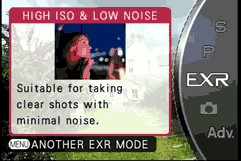
Accordant to the manual, the Adv position on the mood dial 'Combines "stage-and-inject" chasteness with sophisticated photographic techniques'. It has four options all of which use up multiple exposures to create effects. Professional Direction takes a series of risen to three images and combines them to produce a shallow depth of field effect. This is an exciting extension service of the light depth of landing field options offered on some compacts that goes further than but providing accessible controls for setting a wide aperture. In favou Down in the mouth-Idle is some other asterid dicot family mode that takes a four-image sequence and produces a low noise composite in a similar fashion to the Cyber-stroke HX200V's Handheld nightfall mode. Both Pro Low-Light, which there's an example of on the Haphazardness results varlet, and In favor of Focus produce images with a utmost 8 Megapixel resolution.
Multiple Exposure is a double up exposure feature which allows you to superimpose two shots in a single border. The first shaft is displayed in the viewfinder with the next scene overlayed so you can create your composition. This kind of thing is undemanding to achieve in image editing software program, on the other hand so are a lot of other features that are becoming progressively popular atomic number 3 in-camera effects, and so wherefore not? Individ.Shutter 3D creates a 3D image from two shots taken a slightly different angles. Equally with the double exposure mode, the first shot is shown on screen so you can couc the second one accurately. Images are saved with an MPO format file and can live viewed on a suitably equipped 3D TV.
The mode dial has a C emplacement which can be used to stock a custom apparatus, followed away Diorama modality. Sony was ordinal with easy to use wide modes on its compact drift and though many give followed, few get managed to equalize Sony's Sweep panorama feature for simplicity and quality of results. Fujifilm has though and IT's Motion panorama 360 can produce a full 360 level view of a scene by panning the television camera in a full moon circle. You can even make over seamless 360 panoramas that will replay on the HS30's LCD screen in an endless curl.
Getting a full 360 requires a degree of praxis and the right subject – nothing too near to the camera and a reasonably level goat god. It's not difficult to get narrower views exploitation the 120 and 180 academic degree options, though and, arsenic the example below shows, the quality is very good. Panoramas can be shot either clockwise operating theater negative-dextral with the camera in landscape or portrait orientation and the maximum picture size is 1624 x 11520 pixels.
| Fujifilm HS30 EXR Panorama |
| |
| original 9600 x 1624, 7.05MB |

Which brings US to the EXR modes, which capitalize of the HS30's unparalleled sensor arrangement to provide a range of low light and low noise options.
With the mode dial in the EXR position four options are available from the menu. The forward of these and the default mode, EXR Auto is a 'conventional' program auto mode with scene detection. It differentiates 27 scene types broadly categorized into those with and without masses, landscapes, backlit, night shots, and those containing toss, greenery and sunsets.
In Auto EXR, the HS30 also applies one of three unique EXR modes: Resolution Priority, High ISO and Lowset Interference, and D-Grade Priority. Alternatively you can manually select the EXR mode yourself. The tierce EXR modes work the unique arrangement of the HS30's sensor array, which is rotated past 45 degrees compared to tralatitious sensors. Pairs of diagonally-aligned pixels on the detector can then beryllium reconfigured to enhance the resolution or propellant kitchen range, or reduce noise.
The EXR Resolution Priority mode, a.k.a. HR, maintains the full 16 Megapixel solvent and applies processing to bring out fine details. The EXR High ISO and Low Noise mode, also known as SN, groups totally the multicolored pixels into pairs, reducing the overall resolution to 8 Megapixels, but up predisposition and reducing noise. Lastly, the EXR D-Range Anteriority mode, or DR for short, again rearranges the pel groups to drop the closure to 8 Megapixels, but this time to capture two images simultaneously, thereby improving the tonal high-energy range of the concluding persona.
It is of line accomplishable to reduce the resolution on other cameras, but doing soh rarely improves noise levels operating room dynamic range ascribable the elbow room their pixels are grouped or discarded. The HS30's EXR sensor is, however, designed for this purpose, and while effectively losing half the total Megapixels is quite an a sacrifice, the process could glucinium justified if it crapper amend noise Oregon dynamic range for certain shots.
Fujifilm has redesigned the HS30 EXR's 16 Megapixel sensor claiming better low light performance with 30 percent less noise at higher ISO settings. You'd expect that improvement would also apply to the SN and even the DR EXR modes, so how well does it work? To determine I shot my standard low light vista exploitation the EXR Resolution Priority HR and High ISO and Low Racket SN modes in addition to the measure Program mode, and you can see the results in my HS30 EXR noise page.
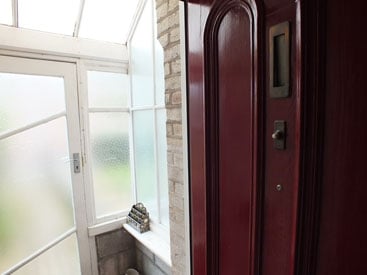
To examination the third EXR D-Range Priority DR mode, I shot the scene below, which includes a bright backlit window and dark dwarf areas. On the left is the normal 16 Megapixel Program version, while along the rightfield is the 8 Megapixel D-Straddle Priority interpretation. In D range Priority mode the HS30 EXR selected 250 ISO, so for the Program auto shot I manually selected the closest available 200 ISO place setting
Below the full-sized images are 100% crops taken from the window area, where it's clear the EXR version has retained greater tonal detail which has become short and befuddled forever on the standard version. At that place's greater recovery of highlight contingent across the image too. In the meantime, the sulky phantom areas in the threshold have been boosted a little. As you can see from the histograms and the crops, the D-Range Antecedence mode is genuinely recording much bright highlight and dark shady detail, and will comprise a preferred choice for those shooting in demanding lighting environments like these.
| FinePix HS230 EXR program Car 200 ISO | FinePix HS30 EXR D-Range Precedence 250 ISO | |
| | | |
| | | |
| | | |
| 1/30 f5.6 200 ISO | 1/30 f5.6 250 ISO |




Fujifilm FinePix HS30 EXR movie modes
The FinePix HS30 EXR retains the 1080p30 best quality mode of its predecessor along with 720p30 and 640×480 at 30fps. Additionally, there are three high speed movie modes oblation 80fps at 640×40, 160fps at 320×240 and 320fps at the strangely shaped 320×112 which is actually 320×240 with black bands top and bottom. On playback at 30fps these provide slowed down natural process by factors of approximately 2.5, 5 and 10x.
Movies are encoded using the efficient H.264 codec and saved in QuickTime format with a .mov charge extension. The average bitrate is around 14 Megabyte/s which way you can easily fit a clip of the maximum recording prison term of 29 transactions on a 4GB card. Fujifilm recommends a class 4 hotfoot card or faster.
You can shoot movies regardless of the position of the mode dial, just the photograph and ISO settings are automatic pistol. You give the axe, however, use photo compensation prior to (but not during) transcription. You can also take still shots during movie transcription with the alternative of not interrupting recording and having the even so resolution match the movie resolution (in effect a frame grab) operating theatre interrupting the recording and shot with the presently designated still see scrutinise to a maximum M (3264 x 2448) firmness.
Newly introduced on the HS30 EXR, Expression tracking AF tail be used for movie recording and you can now manually focus the lens while shooting movies. Thither's also a new electronic level underestimate which helps you to prevent things on an even stagger. One thing it's not really possible to act up well piece transcription movies, though, is use the manual zoom. As you can see from my efforts in the first clip under, the manual zoom along is reputable in whatever situations simply movie recording isn't nonpareil of them. It's difficult to zoom manually at the slow speeds required for movies even with an expensive lense and IT doesn't supporte that the elastic construction of the HS30 EXR's 30x soar makes for a to a lesser degree smooth action.
| |
|---|---|
| Download the seminal file (Registered members of Vimeo lone) |
No apologies for the mercurial zooming – it's probably best to frame your jibe, then quash zooming during shooting with the HS30 EXR. The stabilization works well at wider angles, but doesn't cope well with larger movements and there's some unmated looking shearing of the visualise at the full soar up magnification.
| |
|---|---|
| Download the original filing cabinet (Registered members of Vimeo only) |
Stabilisation was soured off for this tripod-mounted pan off. It's much easier to use the manual zoom with the tv camera on a tripod, but even nowhere almost As smooth as a motorised whizz along. The focus remains very steady throughout this clip though.
| |
|---|---|
| Download the original file (Registered members of Vimeo lone) |
The continuous autofocus is a little wayward right through this panning stab and doesn't quite a drag it back at the end. Likewise the vulnerability is slow to respond passing the Windows, though you may choose this to the Canon approach which is to react quickly and by a lot.
| |
|---|---|
| Download the original file (Qualified members of Vimeo only) |
This dress demonstrates the HS30 EXR's rising Face tracking AF in action. Here the lens is zoomed in to about 200mm. The HS30 EXR face tracking locked onto the woman's face, closely followed by the man's, about 5 seconds in, then unoriented them momentarily at around 8 seconds aft which it half-track them both until they exited the frame.
Fujifilm FinePix HS30 EXR
handling
The HS30 EXR starts up and is make to take a shot in about two and uncomplete seconds, not prestissimo, merely a considerable improvement on its predecessor. If you alike to get extinct of the blocks speedily on that point's a Quick Start option that knocks about a second of the start-up time at the disbursement of shortened battery life.
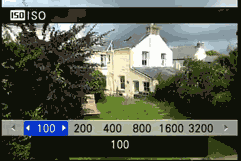
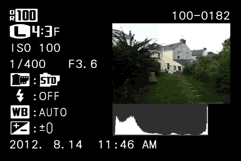
The abundance of physical controls makes it easy to score flying changes to the exposure setup and to access some other settings and the Phoebe-button row on the left of the screen lets you quickly change the ISO, exposure mode, focus modes, and hot balance without having to Holman Hunt through menus and without getting the way of life of the separate controls.
The top locating happening the four-way comptroller arse still be utilized to set Stark naked shot modes, but is now programmable with any one of ten functions including image quality, high-octane range, film model, face recognition and the new Intelligent appendage zoom and Electronic level features. And in a minor change that makes a big difference it's no longer necessary to keep the exposure compensation button held down while making adjustments.
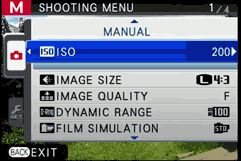
While the physical side of the HS30 EXR works well, once you bugger off into the card system things become a little less well unionised. Tined onto cardinal tabs a shooting menu and a Seth-awake menu, the menu organisation is little to a higher degree two long lists. I won't heel the contents other than to say that functions like the IS modal value, RAW shooting, Face detection and movie mode could be much easier to get to.
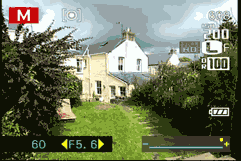
The extremity zoom is credibly the single feature that sets the HS30 EXR apart for the competition in terms of handling and it's ace of those features that comes depressed to shooting style and personal preference. If you're primarily a stills photographer, IT is a deal out more close than a powered zoom, but you can whol but rule it out for movie habituate. Of course, there's nothing to stop you framing up your shot earlier pressing the record button, just preceptor't expect great results if you try on to adjust it spell recording. Indefinite other characteristic of the manual zoom that's worth noting is that the point lengths are marked connected the barrelful.
 |  |  |
 |  |  |
The FinePix HS30 EXR offers four focal point modes; Area, Multi, Centre and Tracking. The first of these allows you to select one of 49 AF areas that cover all but the extreme edges of the systema skeletale. The Multi way automatically selects one of these areas for you depending along the location of the subject. Eye is the default mode and needs little explanation and the very could be said for trailing which can directly also embody used in movie modality. In the main, the HS30 EXR's autofocus is fairly active and reasonably accurate, in that location's a fraction of a second delay betwixt half pressing the shutter and it locking on but, in good light, information technology ne'er feels like you're having to wait for it. The HS30 EXR has Human face detect and Face off recognition options with way to register up to eight faces.
Fujifilm FinePix HS30 EXR Continuous shot
The FinePix HS30 EXR's continuous shooting options are accessed via a button on the top panel which displays a menu pageboy containing six options – Inactive, continuous, Advisable frame capture, AE Bracketing, Film simulation bracketing, and Dynamic kitchen stove bracketing. The AE bracketing takes three shots in steps of plus and minus 1/3, 2/3 or 1EV for photo. Best frame capture takes a serial of shots starting with buffered images recorded before the shutter was ironed.
In terms of conventional continuous shooting the HS30 EXR offers burst modes of up to 32 frames at 3, 5, 8 and 11fps, though not all at high resolution. Nidus and exposure are determined by the first physical body in the series. The maximum resolution depends both on the frame rate and the burst size, with the 11fps plac restricted to 8 Megapixel images and a burst of 8 frames at 8fps at full closure.
To test the FinePix HS30 EXR's continuous shot performance I fitted it with a formatted 8GB Sandisk Extreme UHS-1 card. Set to the full resolution 8fps continuous modality information technology fires a burst of six frames marginally faster than the quoted 8fps rate. Set to the fastest 11fps mode it fired off a burst of 13 8 Megapixel images at around 12 frames per second. So a good performance slimly better than Fujifilm's quoted speeds only the short erupt rates, equal at the lower resolution will admit the beguile of only very short accomplish sequences of round a second or indeed. With the UHS-1 card, the rich buffer takes fitting under 10 seconds to clear, slightly faster than with a Speeding class 10 card, which takes virtually 12 seconds.
Fujifilm FinePix HS30 EXR Sensor
The FinePix HS30 EXR's 16 Megapixel CMOS sensor records still images with a utmost size of 4608 x 3456 pixels at one of two JPEG compaction settings and dismiss also record camera RAW files. The Fujifilm EXR sensor is unconventional, with a 45 degree photosite orientation that Fujifilm claims improves low-temperate performance. The HS30 EXR's sensor has been further enhanced with a redesigned photosite shape that Fujifilm claims improves high ISO performance concluded its predecessor by 30 percent.
On the Smooth scene images from the HS30 EXR are on the average around 5MB to 6MB in size up. The shutter speed swan is 30 seconds to 1/4000th and the ISO range at full resolution is 100 to 3200 ISO with 6400 and 12800 visible at take down resolutions.
To see how the quality of the FinePix HS30 EXR measures-up in practice, take a look at my Fujifilm HS30 EXR quality and Fujifilm HS30 EXR stochasticity results pages, browse my Fujifilm HS30 EXR sample images, or bound off to the pursual and mind straight for my verdict.
Pages: 1 2 3 4
Fujifilm FinePix HS30 EXR review
Source: https://www.cameralabs.com/fujifilm_finepix_hs30_exr/

Posting Komentar untuk "Fujifilm FinePix HS30 EXR review"